
Short Story by Pham Xuan Hieu
The Bowl of fifteen roosters
Flamingo Café on Xa Khơi Street was the usual Sunday morning rendezvous for antique connoisseurs. This morning, patrons were passing around a copy of the Security newspaper reporting on an eighteenth-century Qianlong-era bowl that had fetched 20 million USD. Acquired by Chinese collector Alice Cheng at a 2006 Hong Kong auction, the sum converted to 321.3 billion Vietnamese dong—an astronomical price. Another issue featured a piece on “The Secret of Mao Zedong’s Rice Bowl,” or the “Mao Porcelain,” crafted in 1974 with a starting bid of 3.4 billion dong at a 1976 Beijing auction… Everyone chimed in with an opinion; some called it exorbitant, others a bargain, all chattering excitedly as though they themselves had just missed out on acquiring the priceless artifact.
Indifferent to the lively chatter around him, Thịnh sat lost in thought, taking long, slow drags from his cigarette beside a glass of iced coffee whose ice had long melted, the drink still untouched. His brow was furrowed as he weighed what he had heard the night before. Two of his underlings had come to his house, sold him a few trinkets, and then ruefully recounted a bizarre escapade.
Early the previous month, they had caught wind of a rumor: at the Sea God Temple in a coastal fishing village, there was a bowl salvaged from the ocean floor. They immediately slipped down to the village, mingling with worshippers to verify the tale. The rumor proved true. The ancient bowl seemed to bewitch them on sight. The next day, they returned, loitering around the temple grounds for hours to study the layout. That very night, the bowl vanished into thin air. Having stolen the vessel, they hurried home and buried it beneath the mud of their backyard pond.
At dawn the following day, the two set off in high spirits toward the provincial capital to find a buyer. Barely a short distance down the road, their motorbike swerved into a pothole, hurling them both headlong onto the ground, tearing their clothes to shreds and leaving them scraped raw. Visions of impending wealth drove them to swallow the pain, hoist the bike up, and press on. Yet, inexplicably, not far down the road, the bike veered violently and plunged straight into a flooded rice paddy, submerging them in mud from head to toe. Defeated, they wheeled the bike back home.
They spent the entire day tinkering with the engine to no avail; it would sputter weakly for a moment before dying out. Driven by greed for the elusive fortune dangling before their eyes, they borrowed a friend’s motorbike, determined to scout out buyers at all costs.
This time, only a few kilometers from home, one of them was suddenly struck by a splitting headache, screaming in agony and demanding they turn back immediately.
That night, under the pale glow of a waxing crescent moon, they dredged the bowl up from the pond and began scrubbing it clean, intending to take it to market at first light. The moment their wet hands rubbed against the rim to wash off the mud, a piercing, high-pitched shriek sliced through the night air, sending them fleeing in sheer terror. A sudden premonition of doom gripped them, and they crept back in bewilderment and panic. After standing in silent deliberation, the two agreed to return the bowl to the temple, though the loss tore at their very insides.
Listening to their account, Thịnh deduced that this was an extraordinarily rare treasure. It must have been forged by the hands of a master artisan, harnessing the alchemy of kiln transmutation to endow lifeless clay with both voice and luster. Thịnh had never encountered mention of such a vessel in any historical text. Truly, it was an encounter once in a millennium. He felt a pang of wistful regret, though he reminded himself of an unwritten rule: never covet stolen goods, least of all sacred relics belonging to a temple.
That had been the previous night. Ever since, Thịnh’s mind had drifted endlessly back to the mysterious bowl, unable to break free from its pull.
As if reaching a quiet resolution, Thịnh drained his glass of coffee in a single gulp, pulled out his phone, and called his underlings, instructing them to take him to see the precious bowl that very day.
Two hours later, one of his men brought Thịnh to the fishing village, heading straight for the shrine of the Local Tutelary Deity.
As luck would have it, the village was celebrating the annual festival honoring Điểm Tước, the Sea God. Leaving his companion waiting in the outer courtyard, Thịnh slipped quietly into the inner sanctum, taking in the solemn rituals unfolding amidst swirling clouds of incense smoke. Immediately, his eyes locked onto a rather large bowl glazed in celadon jade, resting upon a low wooden stand, which in turn sat atop a bluestone pedestal at the center of the main hall. From afar, Thịnh could only make out faint cobalt-blue motifs painted around its exterior. He stood transfixed, his soul utterly captivated by its ethereal beauty.
At that moment, villagers – young and old, men and women – were filing in a slow procession around the altar, reverently laying a hand upon the bowl as if seeking its blessing. Thịnh joined the line, inching forward step by step, awaiting his turn to touch the treasure. Only upon drawing near could he clearly discern the exquisite forms of roosters painted around the circumference of the vessel. When his turn came, he deliberately pressed three fingers directly onto the wing of a rooster straining its neck as if about to crow. A cool, glassy smoothness seeped into his skin. He lingered as long as he dared, savoring that incomparable thrill every collector knows upon touching a true antiquity, until the person behind him nudged him forward. Stepping out of the procession, he leaned against the doorway, unable to tear his gaze away from the bowl. Fearing his prolonged staring might draw unwanted attention, he slipped outside a few moments later.
Taking a leisurely stroll around the grounds, Thịnh turned into the side annex and sat down beside the elderly temple keeper, who was preparing betel quids for guests. After steering the conversation deftly toward the bowl’s origins, the old woman readily began her tale:
Years ago, this fishing hamlet had been destitute. Most homes were makeshift shanties woven from bamboo matting to ward off sun and rain. Whenever fierce storms swept in, entire households would have their beds and mats blown away. Men spent weeks at sea only to return with meager catches of shrimp and fish – in good months, barely enough to buy rice; in lean times, scarcely enough for a single trip to the riverside market.
Then, seemingly overnight, the village began transforming day by day as if touched by a miracle. Tiled roofs and multi-story houses sprang up across the lanes, and the once-barren alleys bustled with prosperity. Outsiders stared in disbelief, baffled by the sudden reversal of fortune.
Rumors soon spread that this transformation had begun the day a young couple presented the “Sea Bowl” as an offering to the village shrine. Married for nearly ten years without a child, the pair spent their days exposed to the elements, wrestling with gale-force winds and towering waves, sharing the same hardship as their neighbors. Their thatched, bamboo-walled hut stood right beside the temple, sheltered beneath the canopy of an ancient thị tree.
On one fishing trip, as dusk gathered and their catch amounted to only a handful of fish, their final cast snagged fast on the seabed; no matter how hard they pulled, the net refused to budge. While struggling to free it, Yến, the wife, lost her balance and plunged headfirst into the water. Normally, she would surface within seconds. This time, her husband, Tuấn, waited in mounting alarm as the water remained unbroken. Panic-stricken, he dived in after her. After searching desperately beneath the waves, he found her tangled and thrashing inside the mesh, and hauled her up by her hair.
Though spared from drowning, Yến began babbling incoherently as if trapped in a feverish delirium. Alarmed, Tuấn steered the boat straight back to shore, abandoning their fishing net – the family’s sole livelihood – still anchored in the sea.
The following morning, they had no choice but to set out again, hoping to salvage the lost net. Fortune had not entirely forsaken them; relief washed over the couple when they spotted the net’s floats bobbing atop the swells. Tuấn heaved with all his might, yet the net held fast as though weighted by lead. Left with no alternative, he dived beneath the surface. Once, twice, he failed to dislodge it. On his third descent, his hand brushed against something smooth and slick. Gripping it tightly along with the tangled mesh, he kicked toward the surface. As he hoisted the object over the gunwale and set it inside the hull, a loud, resonant clang rang out – a clear, unearthly chime. Yến gasped, “Oh, what a magnificent porcelain bowl!”
Indeed, it was a white-glazed porcelain bowl adorned with cobalt-blue brushwork of breathtaking beauty. Husband and wife exchanged bewildered glances before hurriedly hauling in the net and sailing home. Until the keel scraped the shore, neither spoke a word, their hearts heavy with unease, uncertain whether the vessel heralded a blessing or a curse.
From that day on, every voyage ended without a single decent catch. With their rice bin empty and no money left for the market, Yến grew desperate and hurried over to an elderly neighbor’s house to ask for a small loan.
The moment Yến reached the gate, the old woman’s voice called out from within: “Out of money again, child?” “For days now, not a single fish has entered our nets, Grandmother. We haven’t a coin left.”
After pouring out her woes, Yến confided in the old woman about the bowl they had dredged from the sea and its uncanny, lingering chime. The elderly woman froze for a moment before whispering, her voice trembling with dread: “No wonder your nets come up empty. Count yourselves lucky neither of you has come to grave harm. How dare you keep a sacred treasure of the sea inside a mortal home? Take it to the temple immediately and offer it to the deities to ward off calamity!”
Terrified, Yến thought back over the days since bringing the bowl home – nothing but misfortune had befallen them. Tuấn had stumbled for no reason, splitting his forehead open; the thatched roof of their kitchen had inexplicably burst into flames…
That very evening, carrying incense sticks and the bowl, the couple climbed the steps of the Sea God Temple. The heavy wooden doors were already bolted, and no answer came when they called for the keeper. Left with no choice, they placed the bowl upon the threshold, lit three sticks of incense, and knelt in prayer: “We are humble fisherfolk, toiling year-round yet never having enough to eat. At sea, we found this bowl; tonight we bring it here to offer unto the spirits, beseeching your grace and protection so that our household may prosper and be spared from harm.” Having finished their prayer, they left the bowl behind and walked home.
Early the next morning, before launching her family’s boat, Mrs. Tâm climbed up to the temple bearing incense and flowers. She was astonished to find a large, unfamiliar porcelain bowl resting on the threshold. The doors must still have been locked, so whoever offered it couldn’t place it inside, she reasoned. As she was sweeping the outer courtyard, a sharp splat caught her ear. Glancing over, she saw a smear of bird droppings staining the rim of the bowl. Startled, she looked up into the foliage above, catching sight of a bird with plumage of emerald green and crimson flitting between branches before vanishing.
She hurried to fetch a cloth to wipe away the defilement, yet no matter how hard she scrubbed, neither the stain nor the foul odor would budge. Walking over to a nearby rainwater cistern, she scooped a ladleful of water and began rinsing the rim. The instant her wet fingers stroked the porcelain edge, a soft, airy whistle rose from the vessel – like the hum of a kite flute in high wind, swelling into a deep, resonant vibration akin to a distant temple bell. Even when she froze and pulled her hand away, the harmonic hum lingered in the air, refusing to fade. Overcome with terror, she dropped the ladle and fell to her knees in prostration, her spirit nearly leaving her body. The ethereal resonance seemed to cloud her mind, stirring a tumult of sorrow, joy, and dread all at once… until she scrambled up and bolted straight home.
As for Tuấn and Yến, the very morning after they offered the bowl to the temple, their first cast netted an entire school of mackerel, filling the boat’s hold to the brim. In the weeks and months that followed, every single voyage yielded a bountiful haul. Within a few short months, they had not only cleared all their debts but saved enough to lend money to neighbors. Stranger still, after nearly a decade of barrenness, Yến finally conceived.
Soon, the entire fishing village experienced an unprecedented abundance of shrimp and fish. Overnight, the shore grew lively with the clamor of buyers and sellers, and the villagers rapidly grew prosperous. Every soul in the hamlet believed with devout certainty that the sacred bowl had transformed their destiny. From then on, not only on festival days but on ordinary mornings as well, villagers flocked to light incense, praying for safe voyages, harmonious marriages, and academic success for their children. The bowl was enshrined upon a stone pillar at the heart of the inner sanctum, venerated by all as a divine gift bestowed by the ocean. After every prayer, worshippers would lightly touch its rim to receive a share of its grace.
Later, when Mrs. Tâm donated funds to renovate the temple, the villagers invited her to serve as its caretaker, tending the lamps and incense day and night. In the quiet stillness of midnight, she would light incense and chant Buddhist sutras, praying for the salvation of all sentient beings. During these vigils, she often brushed her fingers along the bowl’s rim in place of striking the wooden fish or bronze bell; its serene, lingering resonance brought profound tranquility to her soul.
Listening to the caretaker’s story, Thịnh’s mind immediately turned to sunken treasure – and to whatever twin bowls might still lie hidden upon the ocean floor. As a seasoned collector, he knew precisely what he had to do.
At dusk, pale golden sunlight shimmered across the surface of the sea. In the distance, fishing boats bobbed and glided over the waves toward shore. The afternoon market bustled with life; woven baskets and shoulder poles shuttled endlessly back and forth, unloading the day’s catch. Voices, laughter, shouts, and the din of haggling drowned out the crash of the surf.
Making inquiries from boat to boat along the shore, Thịnh finally located Tuấn’s vessel. Stepping onto the wooden plank serving as a gangway, he tilted his chin and asked: “How much do you want for this entire boatload of fish?”
Tuấn eyed the stranger and answered offhandedly: “Ten thousand dong a kilo.” “I’ll buy the whole lot. Take two million as a deposit.”
Thịnh handed a thick wad of bills to Tuấn, then leaned in and spoke in a low, earnest tone: “I’m helping you clear your catch early so we can head back to your place—there’s a matter I’d like to discuss with you.”
That evening at Tuấn’s home, Thịnh sent his men out to fetch rice wine and roasted dog meat so they could talk over a meal. Sipping his cup of wine, Thịnh eased into the conversation: “On average, how much fish do you haul in each day? Balancing good days against lean ones, what does your daily catch bring in?”
Tuấn reached for the bottle, refilled his guest’s cup, and raised his own, his voice booming as though calling across open waves: “I never keep track—only my wife knows the numbers. Why do you ask, sir?”
Thịnh replied unhurriedly: “I’m asking so I can calculate fair compensation for you and your wife.” “Pay us? For what?” Tuấn looked taken aback. “Tomorrow, I want you to take me out to the exact spot where you pulled up that bowl years ago. Dive down and see if anything else remains on the seabed.”
At the mere mention of the bowl, Tuấn shook his head vehemently: “What do you want with things like that, sir? It terrified me so much I rushed straight to offer it to the temple—and yet you’re after it? Strange indeed. I won’t take you there. Besides, we’re right in the middle of fishing season; we can’t afford to lose a day’s work. Please understand.”
Seeing Tuấn’s resolute refusal, Thịnh did not press the matter. He took his leave and headed back, his heart churning with a bittersweet mix of disappointment and resolve.
A few days later, Thịnh returned to the village carrying a bundle of cash, determined to make the voyage. Meeting the couple down at the fish landing, he pleaded his case, yet Tuấn remained unmoved. Once again, Thịnh had to leave empty-handed.
Moved by the stranger’s persistence, Yến asked her husband: “Why won’t you agree to take him?” “Didn’t you see how I nearly lost my life last time? That man needs money; I don’t. For fisherfolk, catching plenty of fish is blessing enough.”
For the third time, Thịnh returned to the fishing village. Before visiting Tuấn’s house, he went straight to the temple to light incense. I bow before the deities, he prayed silently. Grant me the fulfillment of this heartfelt wish, and I vow to repay your grace without fail.
Tuấn and his wife received him on a low wooden platform that doubled as their bed, surrounded by rows of earthenware jars. The pungent aromas of raw fish, fermenting brine, and fish sauce mingled thickly indoors and spilled out into the yard. Feigning interest in buying a jug of pure first-press fish sauce, Thịnh chose his words with care: “To be completely honest with you both, I have a passion for collecting rare curiosities—especially relics recovered from the sea. I’ve already visited the temple and seen the bowl enshrined there; its beauty captivated me. You two have no need for such things, whereas I cherish them deeply. Consider this payment for the fishing trips you’ll miss – please, accept it.”
Gazing at the stack of banknotes Thịnh laid upon the wooden platform, Tuấn remained silent. Yến gently nudged her husband: “Just take him out for a trip – treat it like a leisure outing. He’s come all this way with such sincerity; lending a hand won’t cost us anything.”
Turning to Thịnh, she added: “Please take this money back, sir. If you insist on paying, my husband won’t go.”
While Thịnh hesitated, unsure how to proceed, Tuấn finally spoke up: “All right. Tomorrow morning I’ll take you out—but you must take that money with you. Don’t leave it here.”
At daybreak the next morning, Thịnh boarded Tuấn’s boat as agreed. A brisk wind filled the taut sail, propelling the vessel out toward the open sea. Sitting at the bow, Thịnh drifted into a daydream brimming with anticipation. Beneath those waves, he envisioned priceless ancient jars, vases, and unique porcelain bowls resting silently for a thousand years, waiting for him to claim them… The intoxicating reverie carried him away, dissolving all sense of time.
The boat swung sideways near the foot of a small rocky islet. From the stern, Tuấn called out, “Sir, we’re here.” At once, the anchor splashed overboard, sending up a spray of turquoise water. The small wooden craft came to a halt, bobbing gently amidst the vast expanse.
Biting down on a breathing tube, Tuấn plunged into the sea like a frog. Thịnh strained his eyes, watching the ripples intently, his heart hammering against his ribs.
After surfacing and diving repeatedly without bringing anything up, Tuấn’s compact, sinewy, sun-bronzed frame began to show signs of exhaustion. His rest intervals grew longer. Thịnh solicitously urged him to eat and drink to restore his strength, offering constant words of encouragement.
By late afternoon, they had no choice but to weigh anchor and turn back toward shore. Seeing the downcast expression on Thịnh’s face, Tuấn unexpectedly felt a pang of guilt. He steered the tiller in brooding silence, uttering not a word.
That night, lying beside his wife, Tuấn tossed and turned, letting out heavy sighs. Noticing his restlessness, Yến asked: “What’s troubling you?” “Down on the seabed, I spotted another bowl. I didn’t dare bring it up – I was afraid it might bring bad luck again. Yet seeing how crestfallen that gentleman looked on the ride back, I feel terrible.” “Husband, misfortune often carries hidden blessings. Ever since we found that first bowl, our family has finally held our heads high. I think we should help him – what harm could it bring?”
When Thịnh returned to the village one final time, the moment Tuấn laid eyes on him, the fisherman spoke sheepishly: “I was just hoping you’d come back, sir. Today I must buy wine to host you properly. You left me feeling so guilty… The other day, I wasn’t truthful with you. I wanted to find you and apologize, but I didn’t know where you lived…”
Thịnh had never expected his final attempt to persuade Tuấn to take such a miraculous turn. At Tuấn’s confession, his heart leaped so violently it nearly stopped.
That night, Thịnh stayed at Tuấn’s house. Restless with anticipation, he could not sleep a wink. Every few minutes, he raised his wrist to check his watch. How endlessly long this night drags on. Unable to lie any longer beside Tuấn – who was snoring loudly like a lumberjack in a wine-induced slumber – Thịnh sat up, quietly unlatched the door, and stepped out toward the beach.
Sea and sky merged into a single expanse of pitch black. On this moonless night, faint stars glimmered overhead. Boats large and small rested silently along the sand like sleeping creatures. Thịnh paced along the damp shoreline where the retreating tide preserved each crisp footprint, his gaze fixed on the dark horizon. From a nearby cottage, a young cockerel’s cracking voice crowed into the dawn, stirring the stillness of the early beach. Slowly, a faint blush of rose began to bloom along the distant edge of the sea…
After a full day adrift on the open water, on the afternoon of that unforgettable day, Thịnh finally held the precious bowl tightly in his arms – caressing it to his heart’s content, gazing in rapture at its creamy jade-white glaze and harmonious, lifelike cobalt motifs. Heaven and sea had not failed his devotion; they had bestowed upon him the treasure he had secretly yearned for.
Before parting ways, Thịnh pressed a thick bundle of cash into the couple’s hands. “Consider this a small token of the sea’s bounty – please accept it.” Yet Tuấn steadfastly refused.
A month later, learning that Tuấn was building a new house, Thịnh dispatched his men to deliver all the necessary iron, steel, cement, bricks, and stone as a gift. On the day of the housewarming, before his family, relatives, and neighbors, Tuấn solemnly declared his wish to become Thịnh’s sworn blood brother.
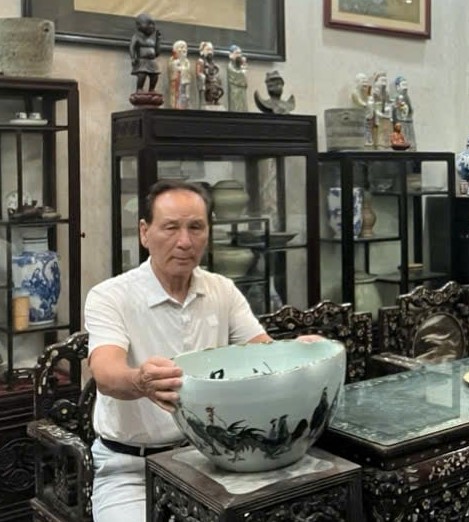
From the day Thịnh acquired the treasure, visitors came daily to his home requesting a glimpse of the bowl. Measuring roughly forty-five centimeters across, glazed in white with three shades of cobalt blue, it depicted exactly fifteen roosters encircling its exterior – each captured in a distinct posture: some pecking competitively over grain, one stretching its neck skyward to crow while flaunting its crimson comb and proud breast, another tucking its head beneath a wing while standing on one leg in sleep, and others ruffling their feathers, beating their wings in mid-clash… Thịnh christened the piece “Thập Ngũ Kê” – The Bowl of Fifteen Roosters.
Inside the basin ran a poem inscribed in cursive classical Chinese, the brushwork fluid and graceful, fluttering like falling petals. Thịnh commissioned a scholar to translate the verses:”An orchid blooms upon the sheer cliff face,Its vibrant hues illuminating mountain wilds;Its fragrance drifts upon the thousand winds,Enchanting every soul that loves a flower.”
Most remarkable of all, every guest who visited begged for a chance to touch the bowl. When dry, whether rubbed firmly or lightly at any point, the vessel remained completely silent. Yet the moment a single moistened finger stroked its rim, an airy, ethereal whistle immediately sang forth. Pressing slightly harder amplified the resonance a hundredfold. Depending on where the fingers rested, the timbre shifted – now a hollow, haunting ooo… ooo… ooo like a signal flute, now a delicate trill like a mosquito-wing reed, or a deep, rolling boom… boom… like distant thunder. Above all, when filled to the brim with water and stroked along its sides with a wet palm, an uncanny symphony erupted as concentric ripples rose across the surface, converging into a shimmering, conical crown of dancing water. Should too large a surface of the palm make contact, the sound swelled to a volume unbearable to the human ear.
Thịnh enshrined the priceless bowl in the place of highest honor, amidst his collection of Song-dynasty lard-white porcelains, Ming-dynasty glazed vases, and Tang-dynasty ceramic figurines. His gallery adjoined his bedchamber. In quiet moments of leisure, he would recline upon a carved wooden daybed, letting his spirit wander across ancient Tibetan thangkas painted with tree resin and mineral pigments rooted in early Indian Buddhism, Ming ink-wash landscapes, and Qing silk scrolls… It was his sanctuary – a space to purify the soul and leave worldly cares behind.
One sleepless night, as was his habit, he wandered into the gallery. Before he could switch on the light, he sensed an unusual, mysterious presence permeating the darkened room. A faint, ethereal hum vibrated softly in the stillness. Startled, he stepped quickly toward the pedestal holding The Bowl of Fifteen Roosters. Sure enough, the porcelain glaze was emitting a faint, luminescent aura, and the painted roosters appeared strangely alive. Earlier that afternoon, several guests had asked to witness the bowl’s acoustic marvel, and the water still filling its basin was now quivering with delicate, expanding concentric ripples.
Suddenly, the clear, resonant chime of a temple bell rang out through the night, and the water inside the bowl trembled violently.
Instantly, Thịnh remembered the twin bowl resting inside the shrine of Điểm Tước, the Sea God, back in the coastal village. At this very hour, the elderly caretaker must be lighting incense, brushing her fingers along its rim in place of bell and wooden fish… and here, across the distance, his own bowl was answering in sympathetic resonance.
He stood motionless in the quiet dark, allowing his spirit to dissolve into a gentle, sacred realm.
Caption: Author Phạm Xuân Hiếu beside “The Bowl of Fifteen Roosters”


















Leave a Reply