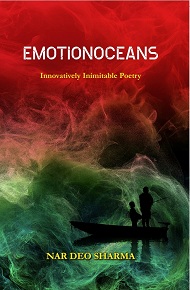

Review Of Emotionoceans
Author Professor Nar Deo Sharma
Published by AuthorsPress India, New Delhi
Price US$ 10/ pages 67

Reviewer—K.K. Srivastava
Very strong poems……..’
Joseph Bruce, Editor, Green Field Review, USA

Prof. Nar Deo Sharma
Professor Nar Deo Sharma taught literature, linguistics and creative writing to post-graduate and graduate students for more than thirty years in University of Rajasthan and various colleges. He has attended many international conferences where his papers achieved very high degree of appreciation. As an expert on linguistics, Professor Sharma has brilliantly brought out in his writings ‘stylistic niceties and the mellifluous metaphors in the wrappings of multipurpose perspectives’.
The collection ‘Emotionoceans’ which the post describes as ‘Innovatively Inimitable Poetry’, though on first reading may appear to be material for simple poetic recitation, slowly assumes a different perspective as it is savoured time and again. This is attributable to the poet’s scholastic qualities in choosing apt and correct words to describe a whole situation or a visualisation. He is able to achieve this by the use of one or two words instead of long sentences or paragraphs. The unique sense of the poet in visualising what he wants to tell the reader and being able to convey it in minimum number of coined words is quite evident in almost all of his creations in this collection. Being an acknowledged expert in linguistics and communication skills there is small wonder in his achievement.
The peculiar style the poet himself describes as ‘I’-centric tempts one to imagine that the recitation or rather lamentation in his poem ‘Remorse’ is really an episode from his own life. ‘I abandoned/my old mother to/her unpredictable lot.’ The explanation the poet himself offers for having adapted such an approach is to prompt the readers to identify themselves when confronted with such a situation in their lives or rather be forewarned and equipped to deal with such a situation. This argument may, to a common reader, appear a bit unrealistic or confusing. But we should give it to the poet in a gold platter – the situation he portrays by his words is life-like. ‘The moments of remorse/now outlive my peace.’
The poet’s topics of appeal are vivid and varied. In the forty odd poems in this collection – one or two with identical names – he traverses over a vide terrain of topics from human characteristics and weaknesses to situations in real life to description or rather his version of the appearance and status of certain places he had been to.
In his opening poem ‘Green Go’ (already published in prestigious The London Magazine) -he compares the dryness of nature’s autumn season without any flair or fragrance to the dry and colourless lives of Indian widows who are bound to live by the conventions in India. ‘The eye-cry-dry-trees are/poised, pieced in pensive prayers/to preen on green go.’ With this comparison the poet tries to bring out the similarities in the phases of nature to the various phases in the life span of a human being who is also an inevitable part of nature. An alert reader will notice the contradiction of Sharma’a imagery when compared to Ted Huges showcasing ‘violence in nature.’
He laments for the present day neglect and forlornness of the city of Jaipur in his poem ‘Pink City: Jaipur’, where he pities the downtrodden lives of the artisans who create such wonderful pieces of art but strive to make both ends meet in their miserable lives. ‘Its roads are broad as/ permissive Europe, America./Narrow are its streets/as scrupulous Asia.’ In a few carefully selected words he draws a most eloquent picture of a city whose adjective lies only in the colour of the walls painted pink.
The self-pity he brings into the poem ‘Show of Sorrows’ ‘men stilled in still mourning/grief froze into their eyes.’ assumes the form of a confession when he admits his deeds as the cause of his mother’s death. Here he brings out that falsehood in human nature with which one tries to cover-up ones misdeeds by lavish gestures, which, he fails to realise, is not worth even a dime in the conscience of the society.
In his poem ‘Soldier’s Memories’ he vividly portrays the soliloquy of a valiant soldier who in one of those rare moments of solitude weds his soldierly thrills to his beloved family life. ‘The jingling of my weapons I take/ for the tingling of your busy bangles.’ The poet’s attempt at conveying a new perspective to the service life of our brave soldiers is quite unique and enthralling.
In the poem titled ‘An Ideal Picture’ the poet’s love and admiration for the father in a house is revealed. His appreciation for the affection of his father and his commitment to care for him in his days of weaning out and helpless old age, are very much evident in his lines. ‘ never dump you/ in an old people’s house as/ a maniac of modernity.’ In the words ‘maniac of modernity’ all his vehemence towards modern day attitude towards parents and the elderly finds expression.
‘Her love stuffed with/the fungus of hate:/ the hub of heaven and hell/ has become our life.’ In ‘Spark of Hope’ he draws before the readers’ eyes a picture of a man poor in his earnings but rich in his yearning for more valuable things in life. His feelings and frustrations when the interests of partners in life are at variance and the ensuing conflicts are penned sincerely.
‘The Best Award’ is a wishful thinking or a dream where the poet visualises his poems becoming instrumental in eradicating all the evils and miseries in the country, which he goes on to describe one by one, and proclaims that such an eventuality would be to him the best award. The poet’s sincerity and commitment to social causes come to the fore in those earnest and simple words.
The recital ‘Poet – A Family Funroll’ reveals the poet’s lighter and humorous side of character. He does not hesitate to make fun of himself in his role as a poet in the family by stepping into the shoes of his father, wife and children and tries to see himself through their perspective. He puts before the reader the situation where one chooses to be a ‘fulltime’ poet when his hobby and profession roll into one, that too a not so successful one, commercially. When it comes to his wife, the poet laments, ‘Staple life with a poet/to marry myriad miseries.’
“Dear to all/ not near to all” – how deftly the poet sketches everything there is to say about ‘sleep’ in his poem by the same name! In the two stanzas that follow the words seem so insignificant before the glowing seven words that qualify the phenomenon and serve as the opening words of the poem.
While unveiling the falsehood and guises the society assumes, through his many poems, the one real ‘hero’ the poet admires in his life is again reiterated and reaffirmed in the poem ‘Father’. He personifies his father as embodiment of patience, endurance and dependability. The poet himself feels proud to have inherited such of those traits.
Poet concludes his collection with a poem dedicated to all Mothers and uses the word ‘oceanic’, which appears in the title of the collection, for the first time to describe his affection which goes on to show how deeply he is affected or encompassed by her love and caring for her children. His emotionally abundant words testify to the great esteem he has for the sacrifices a mother makes for the upbringing and welfare of her children who are for her, her own heartbeats.
Like the poet himself acclaims about style under the disclosure on ‘Poetic Perceptibility’, he has created for himself an inimitable style. His frankness and straight forwardness in dealing with his subjects are commendable. His command over the media of expression and the abundant supply of illustrative vocabulary at his disposal give him that freedom to honestly deal with a topic or rather the ability to delve into it without ever having to restrict himself for fear of any over statement or over expression.
With the practised ease of a trained gymnast he practically hops from one topic to another without fear of any slip but knowing well how precarious his each step is. Here the difference is that his each such step is a beautiful poem. The eagerness with which the poet deals with each topic of his selection sometimes also tend to recall to our minds how a genius student of science seeks new experiences in his laboratory table with minimum of deft strokes of his hand.
Likewise in his approach to an issue of contemporary nature his abstractness is evident. His style lays the subject there before everyone’s eye threadbare for comprehending matters in their true perspective and invites the reader to form his own views and opinions.
Professor Sharma’s every poem is an episode in itself of seemingly small but pertinent and significant issue everybody has come across at one time or another but failed to notice or register in their conscience let alone visualise it. Only when we go through his teeming words do we identify our lives and situations to what the poet has so unobtrusively jotted down in these pages. Everyone who have savoured the poems herein are sure to hear for some time to come the persisting sound of the lashing of waves in the ‘Emotionoceans’. That is one thing for sure.
This is a remarkable collection by a poet who reads and writes to live and not live to read and writes. A highly readable book.












Leave a Reply