
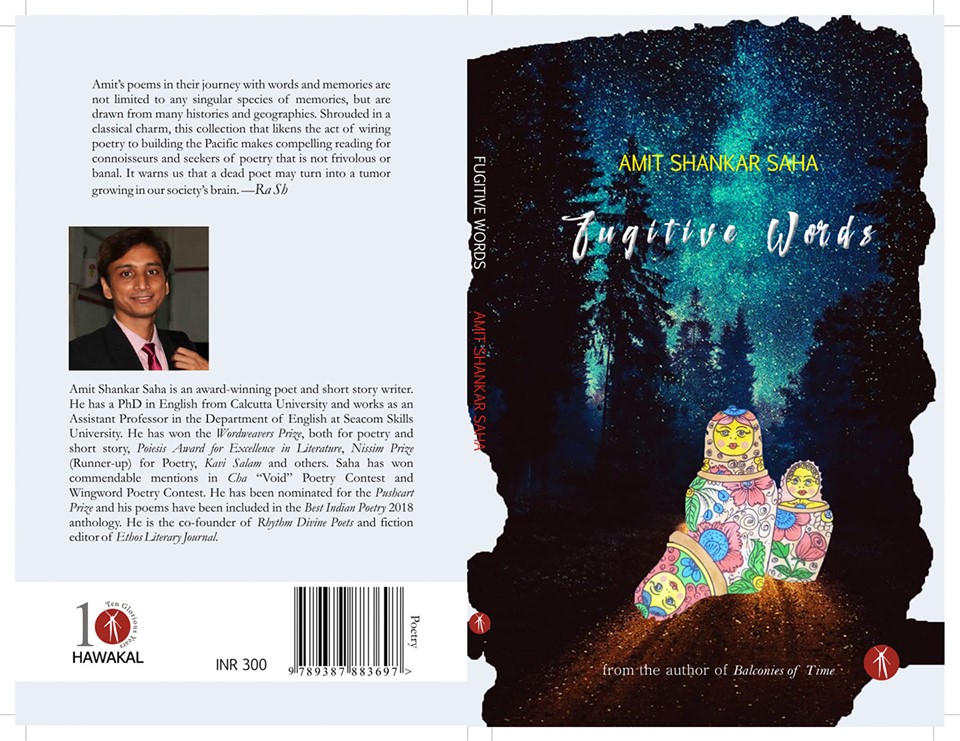

Memory Ecologies: A Review of Amit Shankar Saha’s Fugitive Words
Title: Fugitive Words
Author: Amit Shankar Saha
Page: 101, paperback
Price: ₹300.00
ISBN: 978-93-87883-69-7
Edition: (June 2019)
Published by Hawakal Publishers, Kolkata-India
Fugitive Words is the second collection of poems (first being Balconies of Time) by Amit Shankar Saha, an award-winning poet and short story writer. He is the co-founder of Rhythm Divine Poets and fiction editor of Ethos Literary Journal. As Dustin Pickering, in his foreword to the volume, describes, “Amit S. Saha explores memory and desire through the lens of loss and despair. The grief is beyond personal”. “…As we travel these poems, we are introduced to a scientific understanding that is compatible with humanist spirituality”. Ra Sh in the blurb to the book writes, “Amit’s poems in their journey with words and memories are not limited to any singular species of memories, but are drawn from many histories and geographies.” The poems bring forth the literary mediation of memory and experience set in the narratives of particular time, space and milieu. The understanding of memory mediated through the poems refers to a specific modality of reflection by which the poet examines lived experiences ingrained into poetry. The approach is to arrive at propositions which locate poetry as an archive for memory. In the poem “Paisley”, Amit writes:
You, who will find her one evening smiling
at me while wishing an untimely goodbye
and leave me with you under a roof roofless,
know her footsteps echo an ancient
amnesia of the beginning where
she left paisleys of footprints on the leaves
for generations of my rebirth to see
and not recognize the fossils of the past (25)
Memory here is not referred to as an abstraction per se- but a way of passing through the empirical in order to prepare new entities of interpreting poetry.
In the poem “Spices”, Amit writes,
In Paradise Pickle Factories
smell of grandmothers sits
cross-legged to tell stories
of spices who went on long
voyages across the seas.
In that long long past
Forefathers and foremothers
of fenugreek and cardamom
traded in gold and silver
in the bazars of Persia.
… Today in my turmeric mind
when I recall their memory,
listening to smells, smelling stories,
tastes of a bay-leaf past
seep in with all the oils and cloves. (23)

It is important not to see memory as the inevitable result of merely an accumulation of data or information. The varied fields of poetic representations have changed the contours of memory formation and re-cognition which leads to new conceptual innovations and ideas. Another poem “Your Grandmother’s Sari”, speaks of his grandmother who has left many saris for his mother who wears them now. Along with the saris he is reminded of her habit of having betel nuts. The chief object of Amit’s poem is to determine the relationship between memory of everyday experience, lived events and its translation into poetry.
The poet stoically sits through the night reveals layers of personal passions, social insights and aesthetic delight,
If I remember you tonight,
it is because my fugitive
memory escapes the flaccid hours
spent on the banks of forgetfulness. (“Scattering”,49).
The comparative study of both the written way of representing memory and reproduction of memory is the central argument here.
The poet is quite an expert in economy of words carefully picking and choosing them. The words speak for more than poet himself…
my words, those that live in huts by the tracks,
who owns their lives in this light of dusk?
They clamber into my poems
like a broken bridge half-way into a river,
like a broken roof half-way into a house. (“My Words”,15)
These words are “fugitive words”, they are literal fugitives, they escape the legal proceedings against them and find themselves rounded up in the verses.
I have jailed my heart,
no fugitive words
will escape from it
except in disguise
like those trespassers. (“Fugitive Words”, 65)
The poet thus adopts a human approach to reach those dark fugitive lands of our essence. In this dark land he speaks of rains,
Two drops of water dribble
And settle on a scooter seat but
Their meniscuses don’t meet.
The days become wet and sticky
Like folded damp paper. (“Forgetting the Rains”, 60).
In some of his poems like “This Bijoya”, “Autumning”,”Grey Love”, “Rai”, “Brinda”, “Binodini” Amit does the “code-mixing”, having a dialogue between Bengali and English words, which is integral to the poems ideas of place as well as identity. Words like “Bijoya”, “Hemanta”, “Rai”, “Binodini” reflects the Indianness of the sociolinguistic trends in India. The long poem “Lahore Bomb Blast Series” speak volumes, and pulls the heartstrings!”The Hind Shawl Repairing House” is steeped in nostalgia and leave the readers to ruminate. Fugitive Words uses stored memory for future use and the poems in this collection acts as a repository. Unlike a human mind it is not prone to everyday degeneration. Through these acts one visits, revisits the past as well as the present and future. The artistic cover add to the aesthetic pleasure of the reading experience.

Review by: Sutanuka Ghosh Roy

















Leave a Reply